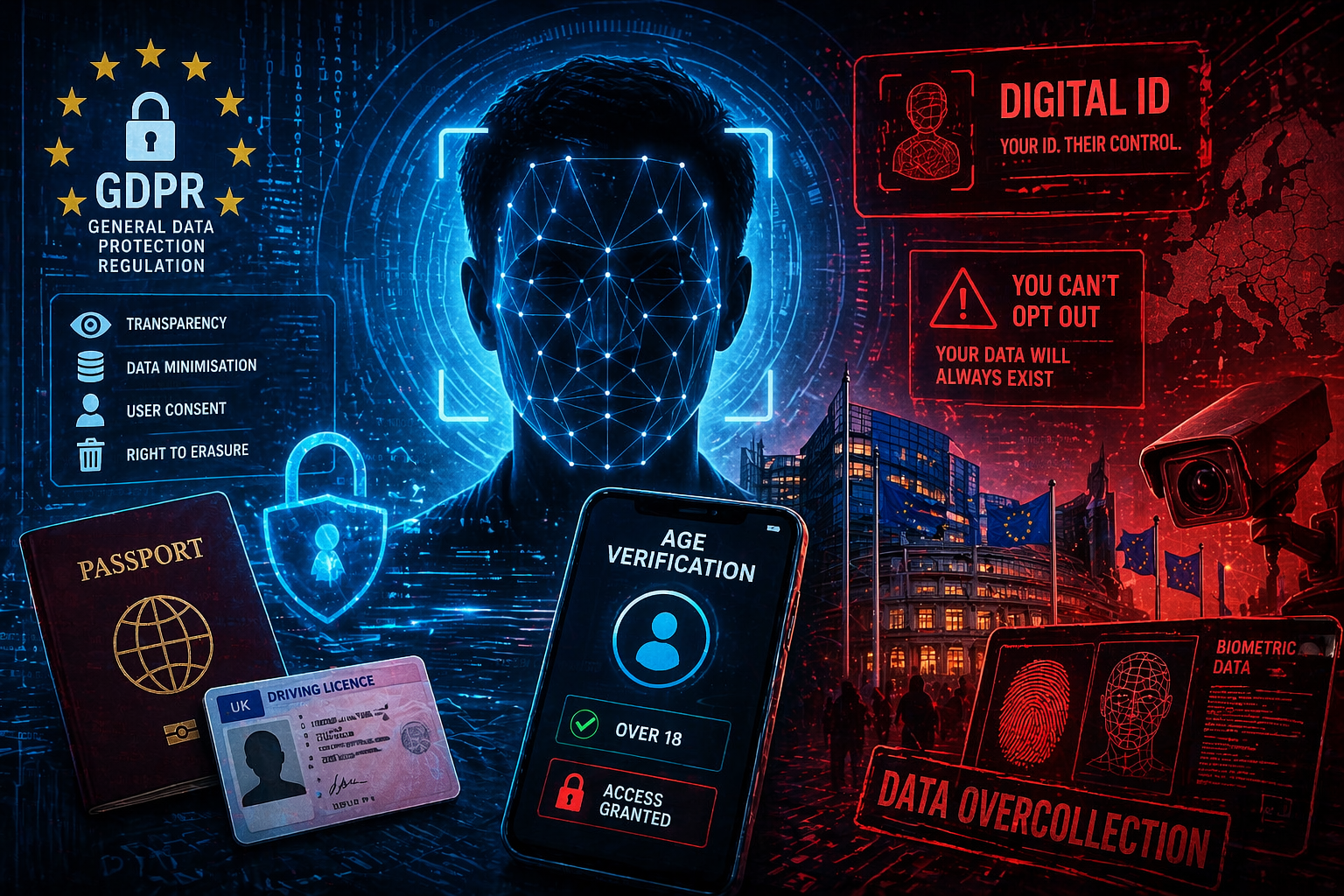
There’s been a growing wave of concern around digital ID systems, age verification laws, and online privacy. Governments across the world — including the UK and EU — are pushing forward with new regulations aimed at making the internet “safer.”
But in doing so, they may have created a much bigger problem.
🔐 What Is GDPR and Why Does It Matter?
The General Data Protection Regulation (GDPR) is a privacy law introduced in 2018 to protect user data.
Its core principles include:
- Transparency about how data is collected
- Limiting how much data companies can gather
- Giving users control over their personal information
- The right to delete your data
After Brexit, the UK adopted a similar framework known as UK GDPR.
In theory, these laws are designed to protect users. In practice, new systems may be undermining them.
🪪 The Rise of Digital ID and Age Verification
New legislation — including the **Online Safety Act 2023 — is introducing stricter age verification requirements.
At the same time, the EU is rolling out its own digital ID and verification systems.
These systems aim to:
- Verify user age for online content
- Restrict access to certain platforms or media
- Provide a unified digital identity for citizens
On paper, this sounds reasonable. But the implementation raises serious concerns.
⚠️ You Can’t Opt Out
One of the biggest issues is lack of user control.
In some proposed systems:
- Your data may exist even if you don’t actively use the app
- You may not be able to fully delete your information
- Opting out completely isn’t always possible
This directly conflicts with GDPR’s principle of data ownership and the right to erasure.
📊 Data Overcollection Risks
Another major concern is how much data these systems might require.
To verify age, some platforms may request:
- Passport or driving licence
- Banking details
- Biometric data (like facial recognition)
Under GDPR, only the minimum necessary data should be collected.
But when multiple services integrate with one system, the definition of “necessary” becomes unclear — and often controlled by corporations, not users.
👶 The Problem With Underage Users
Age verification laws also introduce complications for younger users.
Under GDPR:
- Children aged 13–16 require parental consent for data processing
However, real-world behavior doesn’t always match legal expectations.
In practice:
- Many young users may bypass parental consent
- Verification systems could be used without proper oversight
- Responsibility shifts from parents to automated systems
This creates both legal and ethical grey areas.
⚖️ A Legal Contradiction?
The most surprising issue is a potential contradiction:
- Laws are being introduced to enforce safety and verification
- But those same systems may violate existing privacy laws
This raises a serious question:
Can a system designed to protect users also force them into giving up more data than legally allowed?
💼 GDPR Violations Are Expensive
If these systems are found to violate GDPR:
- Companies could face massive fines
- Governments could face legal challenges
- Large-scale lawsuits could follow
GDPR penalties are known to reach into the millions — or even billions — depending on the severity.
🤔 What Happens Next?
Right now, many of these systems are still new.
That means:
- Legal challenges are likely still coming
- Public scrutiny is increasing
- Governments may be forced to revise implementations
Over time, we’ll likely see:
- Court cases testing these systems
- Changes to how data is handled
- Possibly stricter enforcement of existing privacy laws
🧾 Final Thoughts
Digital ID and age verification systems aim to improve online safety — but they come with serious trade-offs.
The core issue isn’t just security or regulation.
It’s control.
Who controls your data?
Who decides what’s “necessary”?
And can you truly opt out?
Until those questions are clearly answered, the debate around digital identity is far from over.